
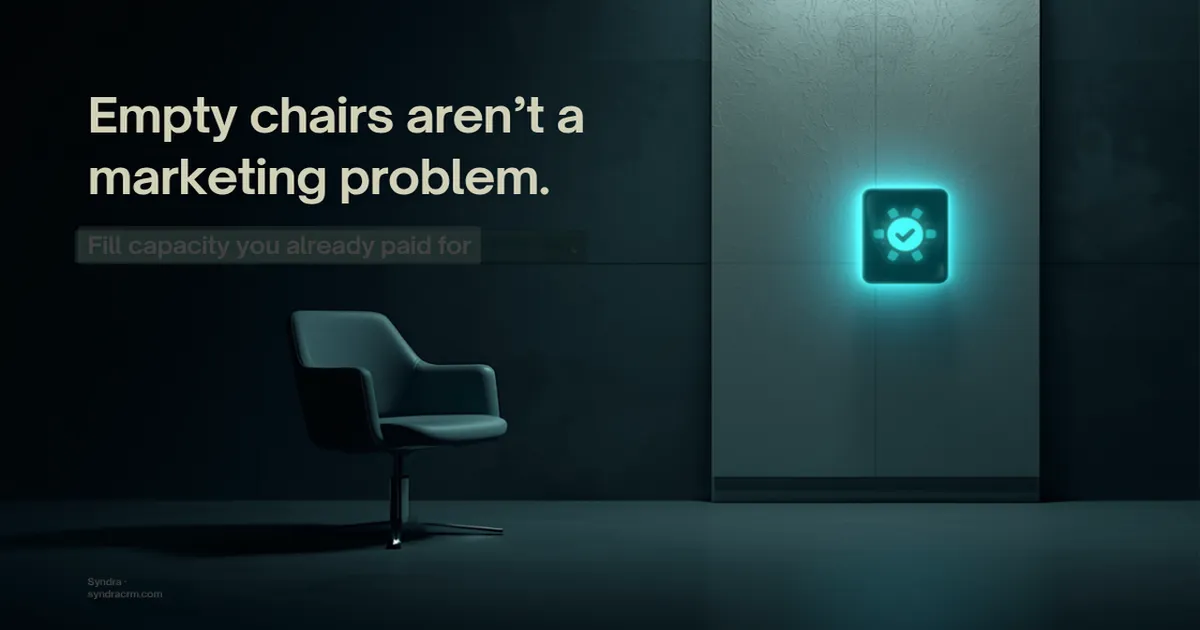
Empty chairs aren’t a marketing problem
You already paid for the hour.
Rent on the chair. Payroll for the table. Time blocked on the book so someone could sit there and get the work done. The cost of that hour doesn’t care whether a client shows — it just sits there, waiting to be used or wasted.
When that hour empties — cancel late, no-show, “I’ll book and never did,” gap that never got backfilled — the first instinct is often marketing. More ads. More leads. Another push at the top of the pipe. Sometimes that’s part of the story. Often it isn’t.
Empty chairs aren’t a marketing problem first. They’re paid capacity that follow-up never finished filling — an ops leak wearing a marketing costume.
Most appointment shops don’t wake up short on craft. The cuts are good. The dogs leave happy. The color sets. What they wake up short on is a finished path between “someone raised a hand” and “that paid hour is protected.” So the chair sits empty, the owner opens the ad dashboard, and the week gets sold the wrong diagnosis.
A Thursday with an empty paid hour
Picture a real shop afternoon — pet, beauty, or any local appointment business where the book looks full on Monday and thinner by Thursday for reasons that never show up in the ad report.
10:00 AM. A slot you staffed is empty. The client who “definitely wanted Saturday” never confirmed. You meant to text openings after Tuesday’s rush. Tuesday won.
11:15 AM. Someone cancels with two hours’ notice. You know three people who asked about this week. Sticky note on the register. You start the next service instead of hunting numbers. The hour stays empty.
1:30 PM. Ad account pings: campaign is “working.” Inquiries came in earlier this week. Half of them never got a clean next step. The paid chair after lunch is still open. The ads didn’t fail at generating interest — the interest never finished becoming a booking that stuck.
3:00 PM. Walk-in asks if you have anything today. You do. You say you’ll check the book and text. The walk-in leaves “to think.” The text never leaves. The chair stays empty anyway.
5:45 PM. You’re tired of explaining slow days as a lead problem. You already paid for the capacity. What didn’t run was the boring middle: confirm, remind, rebook, backfill, follow up while you’re still with the next client — not at 9pm when memory is the only system left.
None of that means the shop is bad at marketing. It means empty chairs got mislabeled. The fix that feels brave (buy more top-of-funnel) is often the fix that pours spend into a pipe that still leaks between inquiry and a protected hour.
Pull-quote: Empty chairs aren’t a marketing problem first — they’re paid capacity that follow-up never finished filling.
Ops wearing a marketing costume
Buying more leads doesn’t fill a leaky follow-up path. If people already asked about openings, already left a message, already said “I’ll book” — and the chair still sits empty — more ad spend just fills a broken pipe faster.
You don’t have a lead shortage first. You have hours you already staffed and chairs you already paid for that never got protected by a finished follow-up path.
Phone-heavy shops feel this as missed callbacks. Calendar-heavy shops feel it as gaps that never backfill. Both are the same costume change: marketing gets blamed for an ops failure that happened after someone already raised their hand.
So the wrong fix shows up first:
More ads — more inquiries into the same unfinished path
Another DIY no-show tip list — usefulaftersomeone is firmly on the calendar, not for the paid hour that never got a confirmation path
Another reminder-template pack — copy to paste when you’re already the admin layer; not a live system that protects capacity while you’re mid-service
“Turn on three reminder types in settings” how-tos — configuration homework, not finished ops
Peers in this category own that tip / template / settings lane for a reason — it ranks. This post is about a different failure mode:chairs you already paid for staying empty because follow-up didn’t ship — not because you needed another ad creative or another policy PDF.
Concrete shop moments (where paid capacity actually leaks)
These aren’t exotic edge cases. They’re the ordinary ways appointment shops lose hours they already bought. Scenes below are illustrative composites — not named client case studies.
The “I’ll book this week” that never lands
Someone loved the visit. They said they’d grab the next opening. You both meant it. No confirmation path ran. No gentle nudge when the week opened up. By the time you remember, they’re on someone else’s book — or they’ve gone longer than they should. The chair you held space for in your head was never really held in the system.
Late cancel with nobody queued behind it
Two-hour cancel. You know people asked. Their numbers live in texts, voicemail, sticky notes, and “I’ll call them after this dog.” After this dog becomes after the next three. The paid hour expires empty. Marketing didn’t fail. Backfill never ran.
No-show that becomes a quiet write-off
Empty chair. You shrug and move on because chasing feels awkward and you’re already behind. Reminder/confirm habits that depend on the owner remembering at 9pm lose to sleep. Soft process reality: protecting a paid hour shouldn’t require heroic memory after a full floor day.
Gaps that ads “fix” by buying more of the same
Campaign looks busy. Phone rings more. Inbox fills. The Thursday 2pm still empties because half the new interest never got a finished next step while you were with the client in front of you. More top-of-funnel into an unfinished path is still an unfinished path — just louder.
Owner-as-admin between every paid hour
Between services you’re not resting — you’re triage: who canceled, who asked, who needs a slot text, which opening can move, which sticky note is still true. The craft gets squeezed by capacity triage. That’s empty-chair ops wearing overalls, not a creative problem.
The slow-day misdiagnosis
End of week. Book has holes. The meeting (or the late-night scroll) becomes “we need more leads.” Sometimes you do. Often the holes are inquiries that cooled, confirms that never sent, rebooks that lived in memory, and cancels that never got a backfill path. Wrong diagnosis → wrong spend.
What “fill paid capacity” means here
Syndra is productized CRM and follow-up for appointment businesses: booking, texts, and follow-up wired so the shop isn’t relying on memory between jobs.
We’re not asking owners to become software admins, paste together another reminder template pack, or run a DIY no-show tip farm. The point of a productized setup is that the follow-up path isfinished and live — so the hours you already staffed and the chairs you already paid for have a real chance of staying filled, confirmed, reminded, and backfilled when life happens.
In plain words, that usually looks like:
Ops before ads — protect and fill capacity you already paid for before buying more top-of-funnel into a leak
Inquiry → book → confirm → remind → rebook / backfill treated as a running path, not sticky notes and “I’ll text them later”
Owner stays on the floor — capacity protection doesn’t wait for 9pm after the last dog or last cut
DFY as setup that runs — productized so you’re not living inside a blank DIY sandbox of tip lists and toggles forever
That is DFY in plain words: the system is set up so it runs. It isnot a promise that every chair fills, every lead converts, or no-shows disappear. Soft process, not guaranteed outcomes. Results vary.
What this means
Empty chairs diagnosed asops first, marketing second
Finished follow-up path that protects paid hours — not another ad pack
Booking + reminders + the boring in-between steps wired once
Soft process language only —no guaranteed booked chairs, recovery %, or income math
What this is not
A paste-ready SMS / email / no-show-policy template cookbook
A “buy more ads and hope” pitch
You becoming the forever admin of half-finished reminder toggles
Guaranteed fill rates, no-show cuts, or “shops like yours make $X”
Finished follow-up vs more ads (and vs tip farms)
Two shops can staff the same Thursday.
Shop A treats every empty hour as a lead problem. Ads stay on. Tip articles get bookmarked. Reminder templates get copied into Notes. Some hours fill. Some don’t. The owner still is the backfill system — and the quiet holes keep getting blamed on “marketing.”
Shop B treats empty chairs as paid capacity that needs a finished path: confirmations that actually send, reminders that don’t depend on 9pm memory, rebook and backfill that can move while the owner is with the next client. Ads can still exist — they amplify a path that already runs, instead of feeding a leak.
Shop B isn’t “better at hustle.” Shop B stopped asking marketing spend to do ops work.
More ads amplify whichever system you already have. DIY tip farms amplify homework when the day gets busy. A finished follow-up path is the mechanism in the middle — the part that turns a raised hand (or a sudden open hour) into protected capacity without demanding a free human in the exact second the book breaks.
That’s the Syndra wedge for appointment shops staring at empty chairs: not another growth hack, not another no-show tip list — productized CRM and follow-up so paid capacity stops leaking into the wrong diagnosis.
Soft proof (process only) + peer contrast
Shops that stop treating empty chairs as “we need more leads” and start treating them as “follow-up didn’t run” tend to spend less energy buying the next campaign and more energy serving the people who already raised their hand — and protecting the hours they already paid for.
Peer content in this category often goes the other way. Public education from appointment platforms leans hard into DIY no-show policies and scripts, confirmation/reminder timing how-tos, “turn on reminder types in settings,” and large reminder-template libraries — the kind of lane associated with Vagaro, MoeGo, Booksy, Jobber, and similar. Fine as educationaftersomeone is on the calendar, or as configuration homework. Different job from shipping alive follow-up path so paid capacity doesn’t sit empty while you’re mid-service and marketing gets blamed for an ops leak.
We’re not attaching invented recovery percentages, fill-rate lifts, call volumes, or “shops like yours make $X back” math here. When we tell a named beachhead story, it will be soft site-story language only — and only after Legal clears that draft.
Soft outcomes only. Results vary.
Who this is for
Owners and managers of appointment / local service shops — pet, beauty, and similar — who are tired of paying for empty hours while the first fix on the table is another ad spend pitch.
Especially if:
The book has holes you already staffed for
Cancels and “I’ll book” moments routinely die in sticky notes
You’ve already tried “just be better about confirming” and the week still wins
Marketing keeps getting asked to fix what follow-up never finished
Advisors who sit next to those owners (tax, books, notary) see the same pattern from the outside: capacity paid for, chairs still empty, marketing asked to fix an ops leak.
Soft next step
If empty chairs are eating the week and the first fix you’re considering is another ad pack, another tip article, or another template folder — pause.
You already paid for the capacity. The useful question is whether follow-up is finished enough to protect it.
Want to see what finished follow-up looks like on a real appointment business — ops that aim to fill chairs you already paid for, not another ad spend pitch? Book a15-min demo withKenn (Demo Owner).
Demo: ask Kenn for 15 minutes
Pricing:https://syndracrm.com/pricing
No fake urgency. Soft outcomes only; results vary.
Syndra · syndracrm.com · Soft outcomes only; results vary.
